
Direct Mail Statistics for Dental Practices: What the Data Actually Shows in 2026
The marketing world is changing fast, and it is hard to know where to turn. Trying to figure out what’s driving results versus what’s holding us back can be challenging. The problem is, there’s no clear, simple, direct line that easily connects the dots. Is your website doing all the work? Does your team convert all the calls? Which campaign is really attracting new patients?
Let’s look at recent data around direct mail and digital marketing. They get talked about like they’re rivals, but the most recent research continues to prove a different story. Whether your practice has run mail campaigns for years or is considering launch, here's what the current data says.
Lob's recent State of Direct Mail report and the ANA/DMA's Response Rate Report show that direct mail earns attention on its own and makes every other marketing touchpoint work better.
Two jobs, two sets of numbers
New patient acquisition mail and patient retention mail solve different problems and perform differently because they reach different people. Direct mail targeting households to attract new patients reaches people who may not have heard of your practice. A retention-style campaign reaches the doorsteps of patients who already trust you. Treating their response rates as interchangeable sets the wrong expectations for either one.
Patient Retention (Newsletters)
Mail sent to a house list of existing or lapsed patients yields an average response of 5-9%, according to the ANA/DMA report.
The case for retention mail gets sharper once you see where the risk actually sits. Practice ZEBRA data, gathered across our network of practice connections since the platform launched in 2017, shows that the average practice consistently has around 23% of patients sitting in what we call the “danger stage,” meaning they haven’t seen you in at least nine months (and up to 24 months, where they are coded inactive). This danger stage identifies your at-risk population before that happens. This is a population most practices can't see in their own software, since a patient who hasn't been seen in nine months could still be coded “active.” It's a quiet kind of erosion, not unlike gum disease: well underway before there's any visible sign of it.
Your own patient base is where a quarterly PATIENT newsletter program is built to reach before they become an attrition statistic. The return shows up in more than reengagement, too: Henry Schein has cited a commonly used industry benchmark of 70-80% of new patients coming through existing-patient referrals, which makes patient communication a quiet acquisition channel in its own right. Patient newsletters are specifically built to keep that referral pipeline active – regular contact gives patients a natural reason to mention the practice to family and friends, while also reinforcing case acceptance for patients who've delayed treatment and reminding lapsed patients that it's time to come back. In surveys we conducted with thousands of dental patients over several years, more than 85% said they appreciate receiving a newsletter from their dental provider. The physical touchpoint, often dismissed in today’s digital-forward world, receives a notably positive reception.
All of us get the “digital fatigue” factor. That’s why most adults engage with their direct mail the same day they receive it. Every dental clinic must have transactional digital communications; they’re expected, necessary, and highly effective at their respective tasks. You need to confirm and remind patients of appointments, you need to ask for reviews after every appointment, and you need seasonal, promotional, and reactivation campaigns. But what those email/text campaigns can’t compete with is the physical connection that happens between you and your patients when a mailed newsletter hits their doorsteps each quarter. It’s tactile, it’s enjoyable, it generates an emotional response, and it impacts memory and recall.
A retention newsletter is an interesting proposition that many dental groups and DSOs are now recognizing. With the slowdown in practice acquisition as the path to group growth, marketing managers are now looking inward at patient retention, case acceptance, and new patient acquisition to drive revenue growth. Solo practitioners should do the same to stave off competition. Just last week, one of my team members had a client call for a patient newsletter because one of their patients came in for their cleaning and had to remove their Invisalign retainer – the dentist was flabbergasted that the patient didn’t know they offered the service. Patient education via a newsletter is underway!
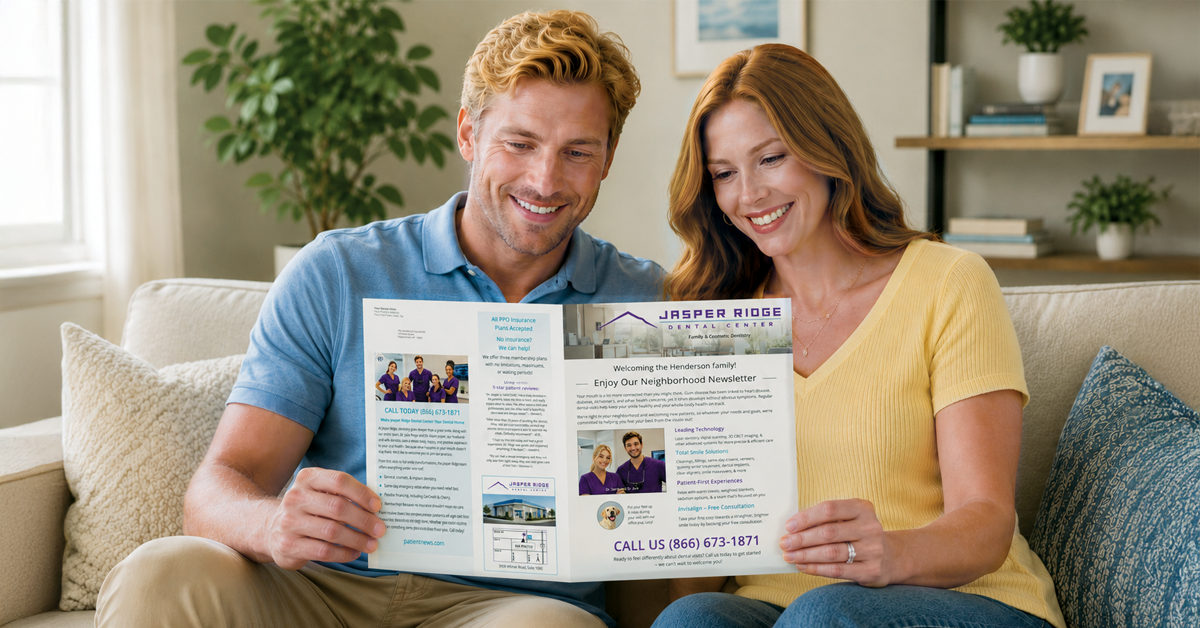
What do you want all of your patients to know? An email blast won’t do it. Even with a 50% open rate, the average practice is missing around 23% of guarantor emails. And a text blast? It’s too short to educate. However, a four-page custom patient newsletter hits 100% of households and stays in the home for at least 17 days.
New Patient Acquisition
On average, our clients generate a 6-8X ROI within one year. According to Lob, companies that see the strongest ROI from direct mail are actually quite a bit like the dentists who use Patient NEWS.
They are:
- 163% more likely to have high-quality data for precise targeting (we do)
- 35% more likely to track attribution with multi-touch models to measure impact (we do)
Further, the report revealed that companies plan to double direct mail volume despite rising costs, as confidence in direct mail as a growth channel has been proven, with 90% of marketing execs saying direct mail augments engagement and conversions across digital channels, improving performance in email, social media, and online ads.
All respondents stated that direct mail stands out for its support of the entire client journey. None of us can deny the sheer physical presence of direct mail. Whether we want to or not, we have to handle our mail when it arrives, and we keep mail that has quality information we are interested in. I mentioned 17 days in home under patient newsletters, but that’s equally true for our four-page neighborhood newsletters. In fact, it’s not uncommon for us to see direct calls from a call-tracking line on a newsletter mailed months and months earlier. Direct mail has legs in home.
Direct mail is tangible, and it’s particularly impactful for dental offices that need to keep chairs full. Dental practices lose patients every year through relocation, insurance changes, and simple disengagement. Dental Economics and Henry Schein both report an average annual attrition rate of 17%, with a wider range of 10-40%, depending on how well a practice manages recall and patient experience. For a practice with 2,000 active patients, that's roughly 340 patients a year who need to be replaced just to stay flat, before any growth goals come into play.
Acquisition mail – like our neighborhood newsletters – that reaches people in the practice's market area, is reported to have an average response rate of 2-4.4%, per the ANA/DMA's Response Rate Report. It's lower than retention numbers: cold prospects need a stronger offer and more repetition to convert than someone who already has a relationship with the practice, but our ROI data proves it’s a valuable investment in practice growth. Consistently generating a 6X return within one year is exceptionally rare in traditional investing. When it does occur, it’s typically associated with very high risk. By contrast, a proven system that gets your name in the households you most want to become patients is a smart business growth investment.
BTW, with Patient NEWS, you get exclusive use of your targeted territory. No competing dental clinic can use our four-page newsletter format to target those households while you have it running, so you get all the benefits exclusively.
Where acquisition and retention mail both benefit from digital
Regardless of which target audience you’re going after, research shows that mail and digital aren't competing for the same attention – they feed each other. When consumers act on a piece of mail, 76% of that follow-through happens via a digital channel: visiting a website or searching the practice online. Thirty-nine percent specifically visit the brand's website after receiving mail, and 38% search for the brand online. That's true whether the mail is introducing a new household to the practice or reminding an existing patient to book.
The audience for mail is widening, not narrowing.
Eighty-five percent of Gen Z and Millennials engage with direct mail, and 67% of that group say they've taken action as a result. That's notable for a generation often assumed to be digital-only. For procedures like implants and same-day crowns, where case value and decision-making patterns vary widely by patient, a channel that reaches across age groups is doing more work than it gets credit for. Plus, direct mail is the most trusted channel at decision-making.
Trust is the differentiator.
Nearly half of consumers say a brand that sends direct mail feels more credible than one that's entirely digital, and that trust premium is specifically called out as strongest in healthcare and financial services – industries where the stakes of “who do I trust with this?” run high. For dental practices competing on reputation as much as location, that's a meaningful edge for both a first impression and an ongoing relationship.
What this means for dental clinics
Whether your practice has been mailing for years or is considering it for the first time, the data points in the same direction: direct mail isn't competing for the same attention as a
Google Ad. It's arriving through a channel that is experiencing renewed growth because digital acquisition costs continue to rise and become more competitive, while physical mail consistently drives a strong ROI, empowering digital channels to be even more effective.
FAQs
Does direct mail still work for dental practices in 2026?
Yes, and the data backs it up. Direct mail response rates run five to nine times higher than digital advertising, and the channel consistently delivers strong ROI across industries. For dental specifically, well-targeted acquisition campaigns consistently help build awareness and attract new patients. Patient NEWS clients track ROI averaging 6:1, with top performers reaching 13:1 to 15:1. The key variables are format, targeting quality, message relevance, and consistency.
How many new patients can I expect from a direct mail campaign?
Results vary based on your market, the size of your mailing area, your offer, and your campaign format. Frequency matters: most patients need multiple exposures before booking, so consistent monthly programs outperform one-off efforts.
What's the difference between a postcard and a newsletter for dental marketing?
Postcards compete in a crowded mailbox with pizza offers and real estate postcards. They also have a short shelf life. Large-format dental newsletters – the kind Patient NEWS produces – are more closely associated with a magazine in the recipient's brain, which means more credibility, more time spent reading, and a longer stay in the home. Patient NEWS data shows newsletters outperform postcards by 70% in dental patient acquisition.
How does Patient NEWS target the right households?
Every campaign starts with demographic and market analysis using Practice ZEBRA. We are uniquely able to break down exact patient spend by neighborhood in order to create like-audiences that match your best patients. That analysis identifies the households most likely to respond based on proximity to the practice, household income, homeownership, family structure, and competitive landscape. The goal is to avoid wasting budget on households outside your realistic draw area or unlikely to respond to your services.
Can direct mail work alongside my digital marketing?
It works better alongside digital than on its own. Combining a direct mail campaign with coordinated digital retargeting increases brand recall by 39% compared to single-channel campaigns, and website visits increase by 77% when mail is included in the mix. Patient NEWS direct mail campaigns are designed to drive traffic to your website, phone, and online booking, so your digital presence captures the response your mailer generates.
How do I measure the ROI of my direct mail campaign?
Patient NEWS tracks campaign performance through Practice ZEBRA, which attributes new patients back to specific mailings by address and phone number, including production value right down to the dollar spent in your chair. That means you're not estimating ROI – you’re reading it directly from your practice data. Practice ZEBRA software provides the most advanced attribution available to dentists for both direct mail and digital marketing solutions.
Is direct mail a good strategy for a newer practice or one that's been struggling with new patient numbers?
It's particularly strong in both situations. A newer practice needs to build awareness in the community quickly, and a precisely targeted neighborhood newsletter is one of the fastest ways to establish a local presence before patients ever start searching online. For practices that have plateaued or are running below capacity, a direct mail campaign specifically designed to build awareness by highlighting the practice's unique value propositions - and executed consistently, a most critical element for a plateaued location - is one of the most direct levers available for increasing new patient numbers and reactivating lapsers. This will even stabilize existing active patients who may not have been seeing your name or your services regularly.
How does direct mail work for dental groups with multiple locations?
Each location gets its own campaign built around its specific brand, market, draw area, and patient demographics. Patient NEWS handles the full campaign per location. Reporting rolls up through Practice ZEBRA and can be shared at the practice, regional, and group levels - giving group marketing managers and DSO operations teams transparent performance data across every location.
Share:

Stay In The Know!
Join 20,000 dental colleagues today!
Subscribe to our weekly updates, and/or request a free brochure and product samples.

