
Out of Network, Not Out of Options

Call Handling For Improved New Patient Flow
When you’re investing in marketing to drive more new patients, ensuring that inbound inquiries are handled fast and effectively is critical to success. A neighborhood newsletter lands on a kitchen counter. Someone spots your practice in a local search. A patient refers a neighbor over coffee. A paid ad earns a click. Different starting points, one destination: the call.
Ongoing research shows that consumers have become less tolerant of poor phone experiences. For sure, I get that, don’t you? Recent 2026 data shows that 76% of consumers have stopped doing business with a company because of a frustrating phone experience, 72% would switch to a competitor after a poor service interaction, and more than 60% of callers hang up after just two minutes on hold. And guess what? Almost 90% of consumers still use the telephone when they need help or service. Expectations have shifted from “call me back” to “help me now.” If a practice isn’t answering the phone or makes scheduling difficult, patients will simply move on to find a better experience.
As a dental marketing company with well over 30 years of experience and well over two million dental patient calls scored, we know the call is where dental marketing spend either converts or quietly evaporates. And there are a few moments within it that cost practices more new patients than almost any other: insurance/fees and convenience.
The insurance conversation can be a make-or-break moment. In the US, more dentists are stepping outside insurance networks than at any point in decades. Recent ADA Health Policy Institute polling put the share of dentists likely to drop at least some PPO networks at around 35%.
At the same time, the American Dental Association reports that most patients misunderstand how out-of-network benefits actually work. Many assume out-of-network means "I can't be seen here," or that their insurance will cover nothing. Neither is usually true. But if that assumption goes unaddressed in the first minute of a call, the caller hangs up and dials the next practice on their list.
Read that again. The patient was interested enough to call. Your marketing did its job. Then the patient walks away over a misunderstanding that could have been cleared up in a sentence. That is not an insurance problem – it is a call-handling problem … and an expensive one.
Consider what it costs to make a single phone ring and what the average value of that new patient means to your practice. (Our client average, based on hundreds of instances in Practice ZEBRA, is around $2,000 per year. You can find your actual average in Practice ZEBRA, and we’re happy to provide a free demo so you can check it out.) When a caller hangs up over an insurance misunderstanding, you don’t just lose one patient – you lose the lifetime value of every cleaning, crown, and referral that patient would have brought over the next decade.
A practice can run the sharpest direct mail in the county and the cleanest website in the market … and still lose new patients at the front desk. Marketing fills the top of the funnel, and the phone is the narrowest point. It deserves at least as much attention as the campaigns that feed it.
So, how do top-performing dental practices do things differently when answering new patient calls? It’s not a magic script, but it is scripting. Plus, they share a mindset, and four things set them apart:
1. They treat insurance or other objections as a transition point, not the end of the call. The insurance question is not a stop, as if coverage were the only thing on the caller's mind. Strong teams answer clearly, then keep the conversation moving quickly. The insurance question is a doorway, not a wall.
2. They lead with care, not cost. The "Do you take my insurance/do you take CDCP patients?” question is rarely the actual goal of the call. Patients call because something prompted it: in marketing campaigns, your newsletter got them interested in a cleaning or Invisalign, or perhaps they have a cracked filling, recently moved, have a partner who nagged them into a checkup, or are dealing with a dental emergency. The best teams settle the coverage question, then ask what actually brought the patient in. That single pivot turns a transaction into a conversation.
3. They swap jargon for plain reassurance. "We're out of network” or “We aren’t participating" without context, lands like a door closing. Confident teams explain, in everyday language, how they can help. Each practice has a system, and depending on the practice goals, the team can offer to explain treatment and payment options. They can also mention that they welcome patients with the plan in question – just handle the paperwork a bit differently – and that plenty of their patients use those exact benefits, or that alternate payment options or member plans are available. Same facts with an entirely different outcome. Don’t just answer the question without helping the patient. Most aren’t asking to get a firm “No, we don’t.” They’re trying to answer, “I like what I’ve seen so far. Can I afford to come here?”
4. They always offer a next step. Explaining coverage without inviting the patient in is a lost opportunity. Top practices close with a specific time rather than an open-ended, "Let us know." Momentum books appointments. Hesitation loses them.
Having a clear, scripted system for everyone who answers the phone makes all the difference. Most businesses require several clear cadences depending on the caller. You’ll have existing versus new patients; new patients and insurance; another for fee concerns; another when there isn’t an appointment time that the new patient wanted; and another for patients who try to stall with “I’ll think about it.” As we know, dentistry is a very personal decision – it’s a perceived high-value spend for patients, even for those with insurance. Successful dental practices know that their front office teams must be extremely polished and professional. They work hard to get the scripting just right, starting with a spectacular and standout greeting like, “Thank you for calling Smith Family Dental. This is Ali. Who do I have the pleasure of speaking with today?”
You want each high-value new patient opportunity to feel welcomed, to know who they’re speaking with, that their business is appreciated, and to feel secure and confident in their decision to call your practice. If you’re looking for new patients, it’s likely you have many dental competitors around you, so every new patient who calls your practice also has many others they can turn to. It’s vital to train for success - professionalism, enthusiasm, helpfulness, and skill. This position is sales. Marketing gave you the lead; now your team has to close the deal.
The referral angle most practices miss.
Paid channels are not the only ones routed through your phone. Word of mouth runs through it, too. When a happy patient sends a neighbor your way, that neighbor still has to call. If they hit the same insurance or fee wall and hang up, you have lost a referral that cost you nothing to earn and everything to waste. Sharp phone skills protect the marketing you pay for and the goodwill you have already built.
Visibility and conversion are two halves of the same machine. Marketing earns the call – call handling decides whether the call earns a patient. Practices that measure one and ignore the other are flying with a gauge missing.
At Patient NEWS, we love working with successful dentists who want growth. Yet even these practices can struggle with call handling. Team members change. Institutional knowledge resides with longer-tenured employees. Standard scripting becomes outdated. Formal knowledge sharing is overlooked. Scripts and call handling between individuals are inconsistent. Patient expectations have changed. We’ve said it before: this position is one of the most important yet most overlooked in many practices. Great front office teams want a greater understanding of practice goals, more training, and better knowledge to improve their results.
That is why the strongest practices close the loop. With Practice ZEBRA, our clients know which campaign made the phone ring and what happened afterward. When direct mail, a search result, or a local service ad produces a call, ZEBRA tracks whether that call resulted in a booked patient or slipped away at the front desk. It also connects the production loop from campaign to actual revenue generated. Campaign to conversation to appointment – connected end-to-end – is where the guesswork stops.
Operations managers at group dental practices love this feature within Practice ZEBRA. Our consistent, AI-informed call scoring (trained on over two million human-scored calls) provides incredible insights to inform decision-making and training investments. Let’s face it: if Ali loses 10 out of 20 new-patient opportunities compared to Kim, who converts 70%, that’s a significant delta that is costing the practice thousands of dollars every month. Note: Our average dental clinic is producing $2.2 million in production with an average new patient value of around $2,000. That’s a lot of table stakes.
Here are two real examples of what can be done … or not.
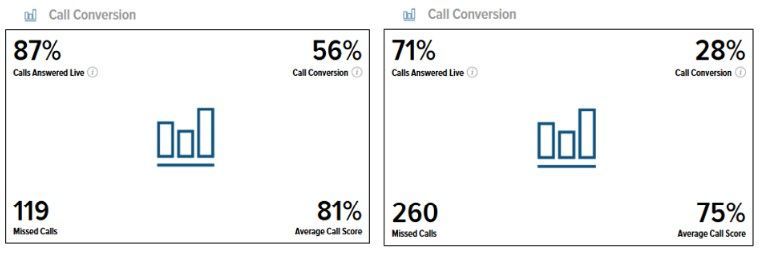
Your marketing is working hard to make the phone ring. Make sure the moments right after it are working just as hard!
Share:

Stay In The Know!
Join 20,000 dental colleagues today!
Subscribe to our weekly updates, and/or request a free brochure and product samples.