
Why do dentists undervalue awareness marketing?
Why do dentists undervalue awareness marketing?
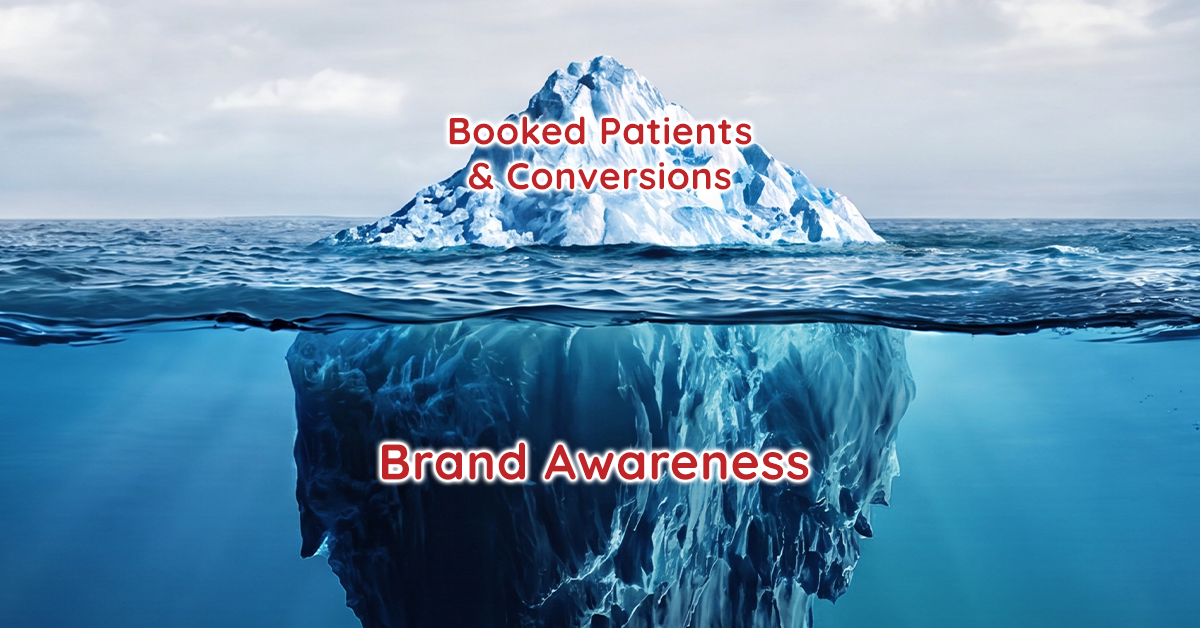
It’s harder to measure. It’s also the engine that runs everything.
Awareness marketing works when nobody is actively buying. This is the hardest concept for business owners to embrace.
Let's look at the environment dental practices are actually operating in right now. The vast majority of people are not shopping for a dentist today. The growth challenge is real, it's layered, and it's getting harder to ignore.
The average dental practice loses approximately 20% of its active patient base every year, with some practices seeing attrition as high as 25% according to industry data across more than 5,000 offices. For a practice with 1,500 active patients, that's 300-400 people walking out the door annually, through no fault of the practice. They move. They age out. They change insurance. Life happens. That attrition is the baseline cost of doing business in dentistry, and it must be replaced before a single new patient can be counted.
At the same time, just half of adults saw a dentist in the past year. A meaningful portion of your local market has decided (consciously or not) that they're fine without you. Adult patients, in particular, tend to underestimate their own dental needs. They're not in pain. They're not prioritizing it. They don't think they need to go.
And when they do decide to look for a dentist? They go online, where your practice is immediately lined up beside every other practice in a five-mile radius, competing on proximity and star ratings with no context, no familiarity, and no pre-existing trust.
Layer on top the fact that economic uncertainty has patients thinking harder before saying yes to discretionary treatment. Only 56% of treatment plans are accepted, and just 46% are actually completed, according to 2025 industry research. Elective and high-value procedures like implants, Invisalign, and cosmetic work are facing longer consideration timelines as patients weigh cost against competing priorities. The ADA's own economic confidence report confirmed that dentists' confidence has reached a new low, with inflation and broader economic uncertainty cited as primary factors.
The competition isn't standing still either. DSOs are growing at nearly 18% annually and now own approximately 35% of U.S. dental practices. They have centralized marketing budgets, brand recognition across multiple locations, and operational infrastructure that solo and small group practices simply can't match on a dollar-for-dollar basis.
This is the environment. And it's the environment in which most dental practices are trying to grow by waiting for patients to find them.
At Patient NEWS, we help dentists get in front of their audience both online and offline. In fact, our clients generate 40% more new patients and have revenue that’s 2X the industry average.
Book a personal growth consultation – we can help you. > Schedule here.
The tracking issue. Google Ads leads to a form. Direct mail pushes a bump in new patients.
Awareness marketing does work differently, but it is very trackable. A direct mail campaign, local sponsorship, billboard, radio spot, or branding campaign influences future behavior over months and years. The effect is distributed across hundreds or thousands of future decision-makers. Because the impact is harder to isolate, dentists may conclude it’s not working.
The irony is that awareness marketing is often what makes all marketing work.
Here's what rarely gets said plainly in dental marketing conversations: awareness marketing isn't just undervalued because it's hard to measure. It's undervalued because the evidence that would prove its value gets lost, distorted, or quietly discarded long before it reaches budget decisions. With Practice ZEBRA, our clients can see how marketing is impacting results through advanced attribution technology that matches target mailing addresses, emails, and phone calls with actual new patient growth. Yet, it's still a struggle because so many opinions can influence decision-making.
Distortion happens in at least three distinct and compounding ways:
The "my neighbor referred me" problem
A patient calls your front desk. The call comes through a tracked number on a direct mail campaign. But when the patient is asked how they heard about you, they say, "Oh, a friend recommended you." Maybe that's true. Maybe the friend's recommendation was the final nudge that tipped the decision. But the practice's newsletter had been arriving at that patient's kitchen counter for five months or two years. The awareness had been building quietly, without drama, and when the friend mentioned your name, it landed on already-prepared soil.
The front desk logs: referral. The campaign gets no credit. The dentist concludes that marketing isn't driving new patients – word of mouth is. And they're not wrong about word of mouth. They're just wrong about what made it work.
The "coincidence" patient
A patient has been receiving your newsletter for 11 months. They've seen your name consistently, read an article about the procedure they've been putting off, and noticed your patient stories. In month 12, they call and book an appointment. The dentist says, "Oh, we've known that family for years. They were bound to come in eventually." The newsletter campaign gets filed under coincidence.
Nothing else changed at that practice. The newsletter launched, and new patient numbers climbed. No new staff. No new services. Just a campaign running, doing exactly what awareness marketing is supposed to do: converting familiarity into action on the patient's timeline – not the practice's.
The “vendor noise” problem
Making this harder still: dental practices today are surrounded by marketing partners who are each aggressively claiming credit for the same results. The SEO provider points to organic traffic. The Google Ads team cites clicks. The website company notes the improved conversion rate. The social media manager shows engagement numbers.
When everyone is claiming credit loudly and with disparate data points, the response from a busy dentist is healthy skepticism of all claims, including the legitimate ones. The result is that practices default to either the most attributable channel – maybe paid search or website, which are also the most competitive and often the most expensive places to win a new patient – or to anecdotal tracking within the practice, which is often hit-or-miss and susceptible to human error.
In 2026, trust in institutions, experts, media, technology, and even objective data has become increasingly fragmented. People are relying more heavily on personal experience, and dentists are trained in clinical science – the tooth is either fractured, or it isn’t. Marketing doesn’t work that way. It shows a variety of metrics, calls, clicks, address/email match, trends, correlations, and lifts. With Practice ZEBRA, we connect patient production to campaigns, but when the answer isn’t perfectly measurable and there’s attribution confusion, dentists can become skeptical. That skepticism is understandable, and it's exactly why transparency in reporting matters. The goal isn’t to claim credit for everything – it’s to show you enough of the picture so you can make confident decisions.
What the research says about awareness marketing
Research spanning 150 brands across industries found that those with high awareness achieved 3X higher conversion rates than those with low awareness. Even a modest jump in awareness produced 43% more efficient performance marketing. The critical insight: there's a tipping point with brand awareness where familiarity begins to meaningfully drive action. Low awareness and performance marketing have to work harder for less. With good awareness, everything gets more efficient.
Put plainly: your Google Ads work better when your brand awareness is stronger. Awareness doesn't compete with performance marketing – it’s what makes performance marketing perform.
In 2026, nearly 70% of marketers report that leads arrive later in the buying journey because prospects have done more research on their own before making contact. By the time someone submits a new patient form or calls your front desk, they've already formed opinions, often based on information they encountered long before that search.
And yet, many practices pull back on the very campaigns building that familiarity, convinced they’ve already reached everyone worth reaching.
Let’s also talk about saturation. Many dental practices assume they've "saturated" a neighborhood after mailing the same area for a year, but the numbers often tell a different story. Consider a practice that has 75,000 residents and approximately 30,000 households within five miles. If the practice has 2,000 active patients and has mailed 5,000-7,500 households for 12 months, the market is far from saturated. Even if every active patient came from the mailing area, thousands of households remain non-patients.
More importantly, awareness marketing is not about reaching people once and expecting an immediate response. Direct mail research shows response rates improve through repeated exposure to the same households. Most households receiving the mail are simply not in the market for a new dentist at that moment. They may be satisfied with their current provider, have recently moved, have no immediate dental needs, or simply are not ready to make a change. The objective is to build familiarity so that when a trigger event occurs, such as a move, a retirement, a poor patient experience, a new insurance plan, or a family recommendation, the practice is already top of mind. What is often perceived as market saturation is actually a market full of future patients who have not yet reached their decision point.
The visibility gap is one of the most expensive blind spots for a dental practice
In a marketing context, not giving awareness its due has a costly side effect: it systematically deprioritizes the channels that quietly do the real work and rewards the channels that can shout the loudest.
Direct mail doesn't shout. Newsletters don't shout. Community sponsorships and consistent local signage don't shout. They build. Month after month, impression after impression, they create the low-level familiarity that makes every other channel work better. And then, when a patient finally acts, some other channel gets the credit.
There's also a layer worth naming carefully and constructively: the front desk team. These are the people who ask, "How did you hear about us?" while simultaneously checking in a patient, answering the phone, and managing the schedule. They're not failing – they’re operating without the right tools.
Patients don't accurately remember their patient journey. They know approximately what they did last: the Google search, the friend's comment, the newsletter on the counter. But they can't map the six months of touchpoints that preceded it. When there's a referral incentive program in place, some patients will name a friend even when the actual trigger was a campaign, because they believe they're doing their friend a favor.
The front desk team's role in all of this isn't the problem – it’s an opportunity. When office staff understands that a growing practice means a more stable, secure career and not just more work, they become important internal advocates for practice growth. Getting team members aligned on what growth means for them personally changes how they engage with the question of where patients come from. They start caring about the answer and not just recording it.
What awareness does BEFORE patients search
When a patient eventually searches for a dentist, they are not starting from zero. They bring with them everything they've seen, heard, or experienced about local dental practices over the preceding months and years.
Before need becomes active, awareness marketing is doing several things simultaneously.
It's building familiarity. Your practice's name, look, and feel become recognizable in the community. Signage, direct mail, social presence, community event sponsorships, and consistent digital ads all contribute to a sense of "I've heard of them." Familiarity is not the same as preference, but it is the prerequisite for preference.
It's establishing trust before any clinical relationship exists. When patients know who you are before they need you, the risk assessment they're doing at the moment of decision is already partially resolved. They're not starting from, "I've never heard of this practice." They're starting from, "I've seen them around. They seem established."
It's shortlisting you before the search. Patients who arrive at a Google search already carrying a name in mind behave differently from patients searching cold. They're more likely to click your listing specifically, more likely to read your reviews with a positive feeling, and more likely to convert. The conversion data confirms this: awareness directly improves the efficiency of every downstream marketing touchpoint.
It's reducing price sensitivity. A patient who already trusts a practice before they walk in is less likely to leave over a cost objection.
Familiarity lowers the perceived risk of the decision, making financial considerations feel less like a barrier and more like a logistics question to solve.
One practice’s story
The chart below shows new patient volume for a dental practice over an 18-month period. In the six months before a targeted print campaign launched (January through June 2025), the practice was averaging 42 to 50 new patients per month, a normal, stable baseline.
The print campaign launched in July 2025. Nothing is ever a straight line, but you can see the lift in new patients 70% to 130% above the pre-campaign baseline. The campaign ended in March 2026. Today, new patient numbers are returning to pre-campaign range.
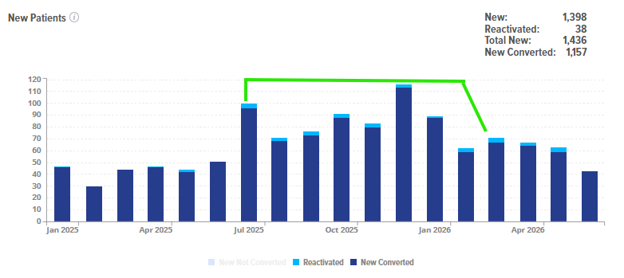
Nothing else changed at this practice during the campaign period. Not the team. Not the services. Not the website.
Two things are worth noting in this data. First, the obvious: the campaign produced a measurable, sustained lift in new patients that tracked almost precisely with the campaign's active period. Second, the less obvious: even after the campaign ended, the post-campaign floor was somewhat higher than the pre-campaign baseline.
Awareness doesn't evaporate the moment the campaign stops. It leaves a residue of familiarity that continues working, at a reduced rate, after the active investment pauses. I checked the data for new patients through today, and they’re still getting more than half a dozen new patients from the campaign each month. Unlike many, this practice manually adds the referral source to their PMS – and even when patients have called from the newsletter tracking line, the office is clicking off "website" or "radio" or “referral”! Direct mail has a shelf life, baby, and that’s awareness! Unfortunately, without giving awareness marketing the value it deserves, results will continue to dwindle over time.
This is what awareness marketing looks like in the data. It's not mysterious. It just requires looking at the right numbers over the right time period, without requiring every patient to have pressed a tracked campaign phone number. It’s not a one-and-done; “let’s test for three months and see” program. Awareness-building is a long-term strategy – one that is highly successful for many practices, and especially when you plan to keep your practice in the same location for some time.
The real competitive advantage
Most dental practices are marketing to patients who are already searching. That's the last mile. It's crowded, expensive, and by the time a patient is searching cold, the practices with strong local awareness have already won a positioning advantage that no bid strategy can overcome in the moment.
The practices growing most consistently are not just the ones with the best Google ranking. They're the ones whose names patients already recognize when they type that search. They're the ones who showed up in the mailbox every month, whose sign they drive past on the way to work, whose community sponsorship they noticed at the little league field, and whose newsletter gave them something worth reading.
Awareness marketing is how dental practices stop competing and start being chosen. Before patients can choose a dentist, they have to know that the dentist exists. Everything else – the website, the SEO, the ads, the reviews – works harder and faster when trust is already in place.
Share:

Stay In The Know!
Join 20,000 dental colleagues today!
Subscribe to our weekly updates, and/or request a free brochure and product samples.