
The Two Numbers Between Your Marketing & Your New Patients

As business owners, we spend real money to make the phone ring. Events, direct mail, paid ads, our website, social, relationships and referrals, branding, collateral, signage, human resources, and much, much more. But at dental practices, many stop measuring at the exact moment the measurement starts to matter, which is when the phone actually rings.
A new-patient call has two moments that decide everything. Did someone answer it? Did someone book it? Those are two separate numbers, and your new-patient count is the product of both.
Calls received × answer rate × conversion rate = new patients
Two multipliers. A great answer rate paired with weak conversion books fewer patients, while top conversion paired with a phone nobody picks up books just as few. Neither number tells you anything on its own. Together, they tell you exactly where your money is leaking.
What the numbers usually look like
The gap between "we're fine on the phones" and reality is wide. Research across the industry consistently puts the share of calls that go unanswered during business hours at roughly one in three, and it’s widely reported that, overall, 50% of new patients are lost at the front desk.
It's really not about moving mountains in most cases
Here are a few live examples from Practice ZEBRA; the graphs below the story are the actual live screen captures I just pulled. We provide our clients with call tracking and scoring for all new-patient campaigns, direct mail, paid ads, and websites. It’s an automatic benefit you receive. If you’d like to find out how you can get more from your marketing campaigns, schedule a call today.
Below, you’ll see four examples. The first practice answers 87% of calls (that’s great; overall, our clients average around 76%) and converts 62% (that’s fab; overall, our clients average around 55%). But still, 130 calls went to voicemail. Did the new patients leave a message to call back? A few will, but most do not, so if the practice had answered half of those, based on their existing conversion statistics, they would have added another 40 new patients – and that’s just from their tracked marketing campaigns and doesn’t include all the other channels this would positively impact. Their new-patient average value is $1,450, so that would have contributed $60,000 to the topline. And this is a one-month view.

Here’s another practice. Their call-answer performance is about as perfect as it can be. If anything, they could look at training for conversion, and particularly insurance handling. If they could have grabbed 15 of those missed calls, at their current conversion rate, they would have added another nine new patients. Their new-patient value is $2,100, so that’s another $19,000 to the topline.

And let’s look at an office with mid-low metrics. They’re answering less than 60% of their inbound calls and converting 50%. A big focus on answering live could have a big impact here.

And one more to round this out. This practice is incredible on conversion but just can’t answer the calls live. With their skill on conversion, they really should dedicate a team to do nothing but answer their calls and put someone else on checking patients in and out so the team can work their magic across all calls.

A peer-reviewed healthcare survey of adults found:
- 72% use the phone to schedule healthcare appointments
- Over 56% said the phone was their primary scheduling method
- Only 20% said an online scheduler was their primary method
Online booking matters. Responding to appointment request forms fast matters. So does answering the phone. Recent data from the dental industry indicates that over 70% of dental appointments are booked by phone, even with online scheduling available.
The thing is, many business owners simply assume that the front desk team is answering inbound calls. But without visibility, we can’t be certain. The truth is, with visibility, we have learned that’s often not happening. It could be that the office isn’t staffed to effectively answer every call, or the front desk team assumes that patients can go to voicemail and they’ll follow up afterward. The front desk may not know or understand the value a new patient brings to the practice compared with the importance they place on rescheduling existing patients. Sometimes, the “love them out the door” campaign for lower-value existing patients is necessary for practice success, making way for higher-value new patients.
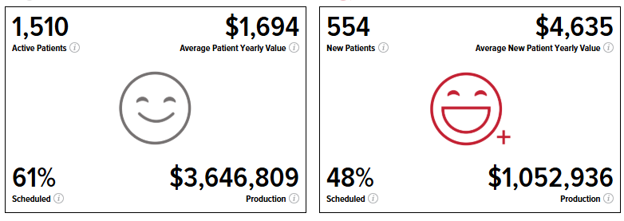
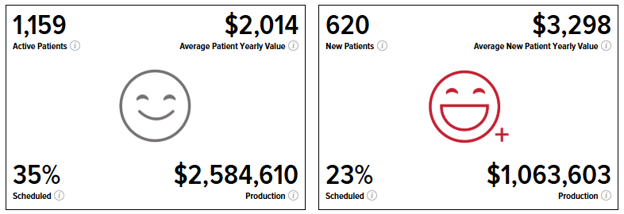
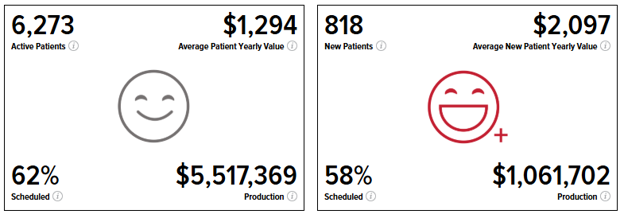
Across the industry, the average annual value for an active patient is around $800. Patient NEWS clients, who again are focused on growth, have an average of over $1,200 per year. That’s a significant improvement over industry average. On the new patient side, our clients average around $2,000 per year, with top producers pushing to $10,000 per patient in first-year revenue.
Active patients on the left, new patients on the right. An actual live example. If you’d like to see your own data in Practice ZEBRA, give us a call. We’d be happy to share how our system works and provide you with a free live demo.
Voicemail costs
Unfortunately, most new patients don’t leave a message and move on to the next office. When a prospective patient reaches voicemail, don’t assume they’ll leave a message. Current consumer research finds that only 42% say they will. And 82% say they’ll call a competitor when a business doesn’t answer.
Even our clients, who are hyper-focused on the call answer metric, still miss 25% of calls on average. Nobody is doing anything obviously wrong. When calls are answered, the greeting is warm, the team is friendly, but the patients who quietly called the practice down the road never show up on any report.
Getting the phone to ring is only half the job. Marketing creates the opportunity – the phone determines how much of it you keep.
The 2011 story
This is not a new discovery for us. We introduced call tracking and scoring early in 2011 to help our clients maximize the results of their marketing campaigns. We were early adopters, and it was a game-changer for all of us. It’s hard to believe now, but back then, this type of technology wasn’t broadly accessible to small and midsize businesses like dental clinics and groups. Even Google didn’t enter the space until around that time. Innovation and product quality are two of our core values, and we were on it when small business call analytics were only beginning to become available. This brought measurable attribution at a time when many dentists were still judging results anecdotally by asking patients, “How did you hear about us?”
Call tracking technology lifted the cover on an area that had quietly impacted marketing results without anyone having more than a gut feeling. Even today, many offices rely on patients to remember how they heard about the practice or what steps led them to the first visit – and on front desk operators to remember to ask patients and use prompts to uncover what contributed. In today’s omnichannel world, it’s often not one simple source. “My neighbor, Karen Smith, referred me.” “And how did the topic of dentistry come up between you? Did you see our newsletter or find us online? Or do you live nearby and have seen our signage?” All of it is subject to human error. Machine marketing attribution by phone, address, and email provides unbiased results reporting.
Oh, the visibility laugh. When we first launched call analytics, I recall one of our clients, the owner of a small group practice, receiving the first results report, which showed that the mail was working, but the phone was not. Their answer rate was low, and calls we’d worked hard to generate were rolling to voicemail.
The client's response was to point the finger back at us: "Okay, now what are YOU going to do about it?" Well, this was new to all of us, and hey, the positive was they had just learned about a problem that had been costing them for years across multiple offices – and not just on Patient NEWS’ marketing-generated calls – with all their inbound new-patient calls. Step one of solving an issue is knowing it exists. But we needed to help, so we built Phone Power, our call-handling training, so the support came with the diagnosis.
We were tracking and scoring calls before call tracking was mainstream. Over the past 15 years, Patient NEWS has human-scored more than two million dental patient calls, continually refining how we evaluate call quality, conversion, and patient sentiment. That depth of experience now informs our AI call-scoring methodology, combining advanced technology with a scoring framework built and validated on millions of real dental conversations.
A practice that’s doing everything right except one thing
Let’s circle back to the office above with a 94% conversion rate. They convert near the top of the profession. What you don’t know is that their average new patient is worth about $7,000 in the first year. By every measure of skill, this front desk is excellent. I showed this graph earlier, but I didn’t include their new-patient value. I’ll say it again. $7,000.
But – they answer 35% of their calls. Every missed call could be worth $7,000 to the practice.

Run it per 100 new-patient calls. At 35% answered and 94% converted, they book 33 new patients, worth roughly $230,000. Across Practice ZEBRA users, our clients average around 76% call answer. But we aren’t suggesting that this team go to boot camp or produce overnight answer-percentage miracles. What if they took baby steps and targeted a goal of answering 15 more calls out of every 100?
At 50% answered, they book 47 new patients, worth about $330,000. That’s 14 additional new patients – about three or four more per week, so not staggering – but an additional $100,000 to the topline! No new marketing spend and no change to a conversion rate that is already excellent. They have capacity. They just need to answer a few more calls.
"So, we'll just answer 100 percent of them.”
You can. A live answering service or an AI agent can push the answer rate to the ceiling. That can be a smart move. But answering is not booking. If those newly answered calls convert at 30 percent, you have spent money to get more people to the exact step where you lose them. A 100 percent answer rate, feeding a weak conversion rate, is a more efficient way to disappoint patients.
Which is the whole point. The answer rate tells you whether you are getting the shot. The conversion rate tells you whether you are taking it.
Track both, or you’re guessing
The practices that win are watching both numbers, by team member, over time, and fixing and tweaking as they go. That is what call tracking and scoring is for: every campaign's calls are logged, every answered call is scored, so "We're doing fine on the phones" becomes a number instead of a belief. And because those two numbers sit inside the same view as your marketing spend, new-patient value, and production, Practice ZEBRA shows you the whole chain from the dollar you spent to the patient you booked.
Small, measured changes to the right number compound quietly, month after month. The practices that never look never find them.
Share:

Stay In The Know!
Join 20,000 dental colleagues today!
Subscribe to our weekly updates, and/or request a free brochure and product samples.