
Your Patients Are Talking. Is AI Listening?
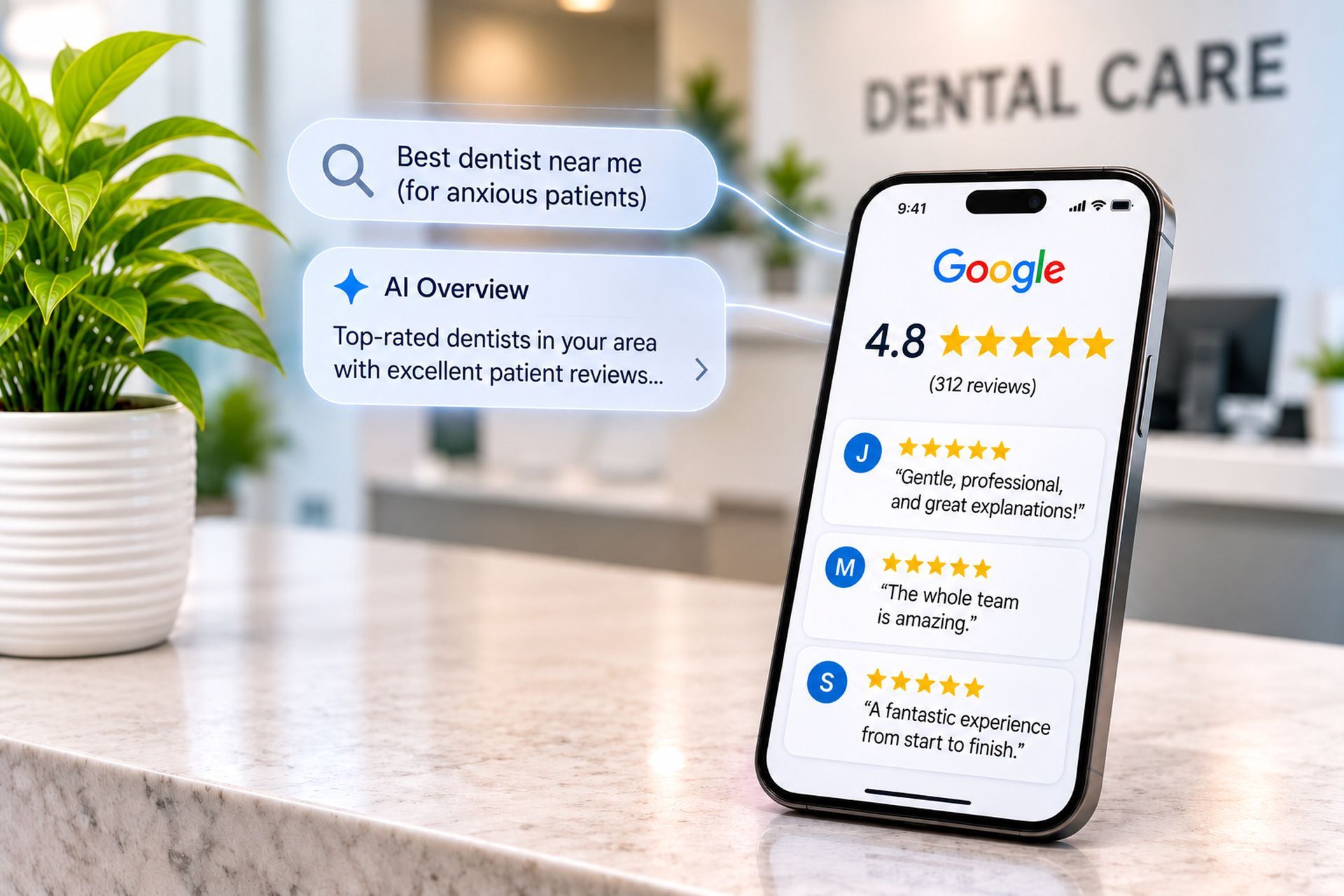
Why your dental reviews deserve a closer look before 2027.
Imagine a prospective patient running a search query or asking AI to recommend a dentist who is great with anxious patients, explains treatment options clearly, or offers clear aligners close by.
Your website might have all the right answers. But what are your patients saying?
The experiences patients are voluntarily sharing online about your practice deserve a closer look. As 2027 approaches, there’s no better time to check that your online reputation reflects the practice you’ve worked so hard to build.
First off, Google is still the front door!
AI use is real, and it’s growing fast, but most people still start their search on Google. Sixty-one percent start their search on Google versus 8% on an AI tool. The journey might look something like starting with Google Search, encountering an AI overview, clicking into a dental website, then using AI to compare practices. According to a BrightLocal 2026 study, at any point in the journey, 71% used Google, 30% social media, 29% Google Maps, and just 23% used AI tools. According to Statcounter's October 2026 figures, Google’s share of traditional search has remained steady at the 90% mark.
As of today, even though things feel like they’re changing lightning fast – and they are – Google isn’t going anywhere, so be sure you have a solid foundation in your website and SEO work. But the way patients search is changing, so let’s talk patient reviews.
Review-reading behavior is stronger than ever. 97% read online business reviews, and 85% said positive reviews increase their likelihood of choosing a business. Reviews often send patients straight to your site: consumers are most likely (54%) to visit a business website after reading positive reviews. Your website makes the claims, but your reviews are where patients decide whether to believe them!
The bar is rising. Sixty-eight percent of consumers now require a minimum of four stars, up from 55% the year before, and 31% will only use a business rated at 4.5 stars or higher, up from 17%. A rating that looked healthy last year may be quietly costing you new patients this year. And now AI is part of the conversation. If you already know you want to do more to improve your online reputation, now is the time to learn more about your options.
Book a FREE DEMO to see how we can help.
Today, 82% read AI-generated review summaries. (I personally like them, but verify by reading both positive and negative reviews to see if I care about the things other people didn’t like.) And it’s not just me. Patients who use AI still double-check. Eighty-eight percent of AI users check AI recommendations, while 97% sometimes compare AI recommendations with real reviews. Whether a person starts with Google or with AI, your reviews end up in the deciding seat.
There’s no arguing that reviews are important for the patient, Google, and AI. But more than what they say, review volume is one of the clearest differences between practices that appear in Google’s local map results and those that don’t. Several current studies show that review volume is measurably related to being shown and recommended.
In a 2026 study of more than 16,000 Google Business Profiles, Localo found that profiles with 201 to 500 reviews ranked in the top three 73% of the time, compared with 39% for profiles with only one to five reviews. Profiles below about 25 reviews were mostly off page one, and top performers clustered around 100. The benefit levels off after a couple hundred reviews. Chasing a perfect 5.0 matters less than most would think, since average ratings across all ranking positions fell within a narrow 4.76 to 4.82 range.
What you want to do is make review requests a routine part of every patient visit rather than a one-time or cherry-picked selection. Volume, quality, and recency will continue to play critical roles in helping your practice rank well, be visible, and ultimately attract more new patients. And don’t forget to respond to your reviews because 89% of people expect a business to respond, 80% will use a business that responds, and 42% are unlikely to use a business that never responds. Also, do it yourself (for real) because 50% are unlikely to choose a business that uses generic or templated responses.
Here are five questions to ask when it comes to your reviews.
- Are your reviews telling a story or just collecting stars?
Both matter, but in different ways. Some AI tools can’t read review text directly, so they lean on what they can see and synthesize from various sources: how many reviews you have, how recent they are, your ratings, and those published on your website or other publicly retrievable text. For example, ChatGPT currently can’t reliably open a Google reviews panel because much of that content is loaded dynamically. This makes review volume, ratings, and information from third-party sources important. Count and freshness help get your practice considered. The written review still does real work with people, as do Google’s own AI summaries, which are built from what patients say. When many patients independently mention gentle care or clear explanations, that pattern shapes how your practice is described. - What is AI learning from your patients?
Review content contributes to the information AI tools gather about your practice. Google summarizes reviews with AI, and ChatGPT now draws on Yelp, which presents dentists with an interesting challenge. ChatGPT will surface Yelp reviews, ratings, photos, and other business details in its responses to user queries. This is a more limited view and doesn’t outweigh the impact of Google reviews as the biggest goal area. But for dentists, Yelp prohibits businesses from soliciting reviews, so the data is a small share for ChatGPT to draw on. Rest assured, it’s not the only source it will look to. It’s important to maintain an accurate and complete Yelp profile, monitor reviews, respond professionally, and continue to proactively request genuine Google reviews. Volume matters here. In a study of over 1,600 dental locations, the practices mentioned in the AI models averaged 643 reviews, compared with 253 for those AI models never mentioned. The strongest takeaway is that AI systems will continue to evolve, making the sources behind the practice’s online reputation increasingly important to understand. - Are you asking at the right time?
The best moment is shortly after the visit, while the experience is fresh and the patient is back on their own phone. A simple text or email with a direct link makes it easy. Keep the invitation open and honest, and don’t suggest what to write. Google’s policy states that merchants should not require or pressure users to leave ratings or write reviews while on the premises, nor should they request that specific content be included. When asked kindly, most patients are happy to leave reviews. And when you get those reviews, remember that patients took the time, so it’s important that you also take the time to say thank you. - Is your team asking consistently?
An automated request is a good start. But a friendly word from the team at checkout, letting patients know their feedback matters, makes that request more likely to be answered. The key is consistency. Invite every patient, not just the ones who seem happy. Avoid review targets or contests for staff and never ask patients to mention someone by name. Google now explicitly prohibits merchants from requesting that staff solicit a certain number of reviews and from requesting content that includes a staff member. Just consistently ask every patient and then say thank you when they post. But be careful with your review response. It’s important that you avoid confirming a treatment relationship, so the simple rule is: Yes, always thank the reviewer. Acknowledge the feedback. Never confirm patient status or repeat treatment information. Make responses personal without disclosing information. Handle negative reviews privately; invite the person to contact the office without confirming a patient relationship. - What does your reputation say about your 2027 readiness?
Consider a dental reputation competitive audit. Take a look at seven factors:
- Review volume: Google, Yelp, Facebook, and other relevant platforms.
- Review growth: How many per month for the past three to six months. Are you actively growing?
- Review recency: Date of newest review; percentage posted within 30 and 90 days.
- Star rating: Where are you? This provides an immediate consumer confidence signal.
- Review content: Specific services, team mentions, patient experience, compliments, complaints – what do patients actually value, and how is the practice differentiated?
- Response performance: Time to respond, quality, and personalization.
- Competitive position: Compare volume, rating, velocity, and recency with five or more competitors.
It’s an ever-changing world, and it’s not getting any less complicated. But we’ve done a lot at Patient NEWS to help our clients navigate and grow through it all. Maybe that’s why our clients generate 40% more new patients than industry average!
If you got this far in my article, amazing – thank you! Now you may know us because we are a dental marketing company, the direct mail people, or the website and Google Ads guys, but we are also the developers of Practice ZEBRA dental software.
Hundreds of dentists use and love Practice ZEBRA; its primary purpose is to help them track marketing results using advanced attribution. It houses hundreds of key performance metrics and offers some amazing automated patient communication solutions. One of those is Review BOOSTER reputation management for dentists.
More Reviews. Stronger Reputation. More Reasons To Choose You.
Building a great online reputation takes more than great service. It takes consistency! Review BOOSTER makes it easy to request Google and Facebook reviews via automated emails and texts, respond to feedback from a single dashboard, and track your review performance over time. Many solutions don’t bother with email, but that component allows you to add value to your patient communication, as each email includes an educational oral health article and the patient's next appointment dates, providing more of a feeling of reciprocity towards your services.
In fact, our clients generate 3X more reviews after implementing Review BOOSTER. With a steady flow of fresh reviews and the tools to manage your reputation, you’ll give prospective patients more reasons to feel confident choosing your practice.
Book a
free demo and see how easy it can be to put your reputation to work!
Share:

Stay In The Know!
Join 20,000 dental colleagues today!
Subscribe to our weekly updates, and/or request a free brochure and product samples.

